
From SEO to AEO & GEO
How to Win in AI Search?
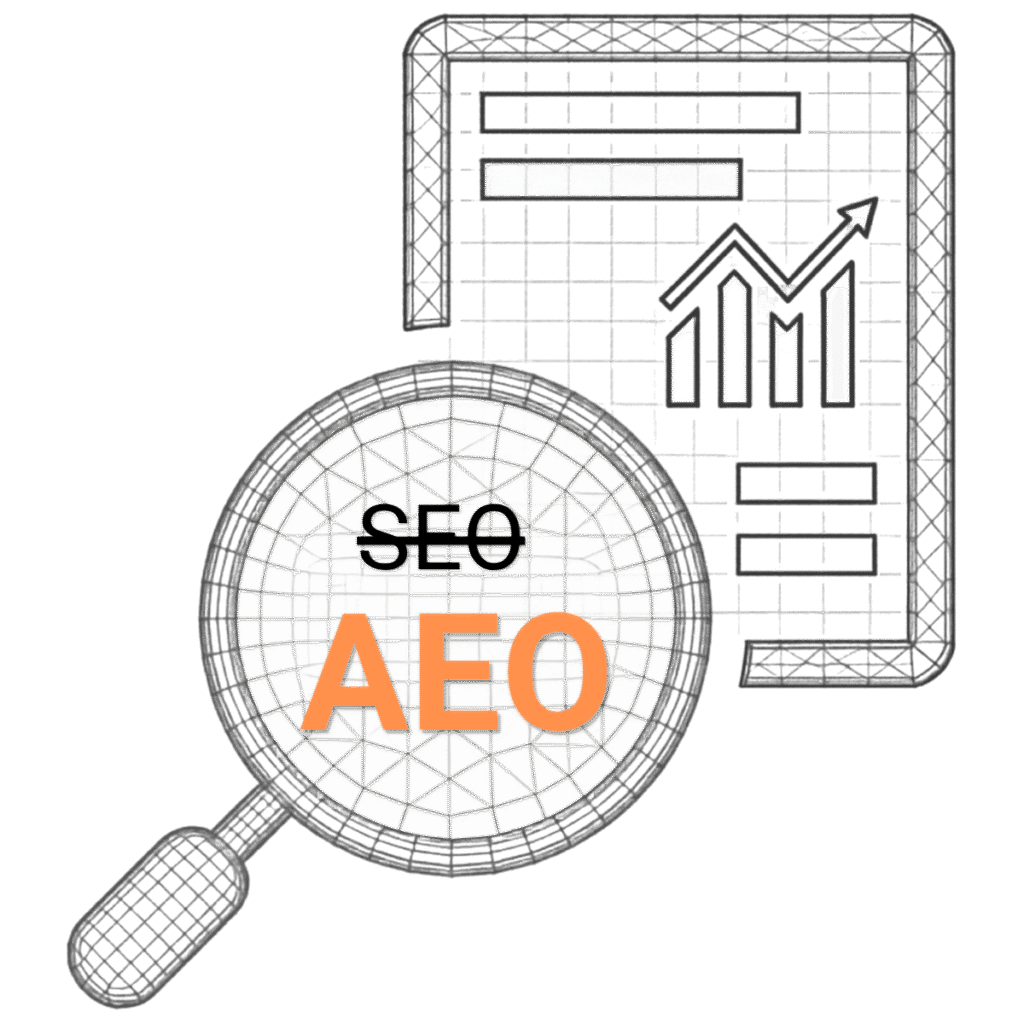
Search has changed more in the last 18 to 24 months than in the previous decade. Google’s AI Overviews, Microsoft Copilot, ChatGPT, Perplexity and other AI assistants no longer just point to websites – they answer questions directly, often without a click. In this world, brands must optimise not only for traditional search engines (SEO) but also for answer engines (AEO) and generative engines (GEO / AI).
Is Your Business AI-Ready?
Take our interactive checklist to see what you already have in place and uncover the exact areas you need to work on.
Take The Free Assessment1. What Has Changed In Search & Marketing?
1.1 AI Overviews and the rise of zero-click answers
In May 2024, Google rolled out AI Overviews to users in the U.S., with a plan to reach over a billion people. As AI answers sit above classic blue links, the share of searches ending with no clicks jumped from 56% to 69% in key sectors.
Source: Similarweb Zero-Click Searches Report1.2 AI becomes the default marketing co-pilot
Generative AI has moved from experiment to everyday workflow. In McKinsey’s 2024 State of AI survey, 65% of organisations reported regularly using generative AI, nearly double just ten months earlier.
Source: McKinsey – The State of AI 20241.3 Generative AI reshapes traffic, ads & measurement
US advertisers are projected to spend nearly $26 billion on AI-powered search ads by 2029, representing about 13.6% of total search ad spend. Meanwhile, 93% of CMOs using GenAI see a clear return on investment.
Source: eMarketer Forecast2. From SEO to AEO and GEO
To win in generative search, it helps to clarify the three distinct layers of optimization:
SEO (Search Engine)
- Focuses on crawlability, indexing, and ranking.
- Keywords, backlinks, and Core Web Vitals.
- Primary outcome: Blue links visibility.
AEO (Answer Engine)
- Optimising for direct answers (voice/snippets).
- Focus on FAQs, How-Tos, and entity clarity.
- Heavy use of structured data / schema markup.
GEO (Generative Engine)
- Making content easy for AI models to understand & cite.
- Requires citations, original statistics, and expert quotes.
- Multi-platform visibility (ChatGPT, Perplexity).
3. What Should Businesses Look For?
Discoverable & Cite-Worthy
- Allow reputable AI crawlers (GPTBot, ClaudeBot).
- Write with clear headings, FAQs, and concise summaries.
- Include unique data and references.
Entity-Based Authority
- Strong About pages and Organization schema.
- Focused product pages and case studies.
- Credibility via reviews, awards, and certifications.
Measure AI Visibility
- Track brand mentions inside AI answers.
- Monitor Share of Voice across AI assistants.
- Attribute AI-influenced sessions to revenue.
Business Outcomes
- Define GEO goals in business terms (Pipeline, CAC).
- Maintain accurate, compliant AI-assisted content.
- Review outputs for regulated industries.
4. Readiness Checklist Criteria
Click the sections below to explore the core criteria for AI Search Optimization.
- You have a documented GEO / AI search strategy aligned with your wider digital roadmap.
- There is a dedicated GEO budget and cross-functional task force (content, SEO, product, data, legal).
- Leadership understands the difference between SEO, AEO and GEO and actively sponsors the program.
- Content is conversational, intent-led, and organised into topic clusters with strong pillar pages.
- High-value assets include original research, proprietary data or unique frameworks.
- Author bios, case studies and stories highlight real-world experience and expertise.
- Schema markup (FAQ, HowTo, Article, Organization, Product, LocalBusiness) is implemented.
- Robots.txt intentionally manages AI crawlers according to your policy.
- Site is technically clean: fast on mobile, secure (HTTPS), with solid internal linking.
- Content shows first-hand experience, process transparency and real outcomes.
- Team profiles highlight relevant credentials, certifications and publishing history.
- Reviews, testimonials, policies and processes are easy to find and up-to-date.
- You track AI visibility, citation rate and share of voice for your key topics.
- GEO-specific KPIs and dashboards are defined and reviewed regularly.
- Competitor mentions in AI answers are monitored to identify content gaps.
- Content is structured so assistants like ChatGPT and Perplexity can easily quote it.
- For Google AI Overviews, you optimise for snippets, FAQs and structured data.
- You maintain platform-specific Action plans as AI search products evolve.
Are You Ready for the Future of Search?
Don't get left behind by AI Overviews and Generative Engines. Take our interactive assessment to see what you already have in place and uncover the exact areas you need to work on.
Test Your Website Now