
AI Search
Robotics & Automation News
Where Innovation Meets Imagination
by
By Livija Kasteckaitė
Industrial robotics and automation markets are growing, and that growth brings denser competition and more fragmented buyer journeys. The International Federation of Robotics reports 542,000 industrial robots installed in 2024, more than double the number a decade earlier, with the global operational stock reaching 4,664,000 units in 2024.
At the same time, industrial buying has moved decisively toward self service digital research. McKinsey reports rising expectations for a sophisticated buying experience and documents a global survey of nearly 4,000 B2B decision makers across 34 sectors.
Search is also changing structurally. Google’s AI features, including AI Overviews and AI Mode, can expand how users discover sources, using techniques like query fan out and surfacing supporting links. Google is explicit that foundational SEO best practices still apply and that there are no special optimizations required specifically for AI features.
If your robotics company is not discoverable when engineers, integrators, and procurement teams research specifications, integration constraints, and total cost of ownership, you lose pipeline before sales ever gets a chance to compete.
In robotics and automation, buying risk is real. A poor fit can mean downtime, safety exposure, rework, and delayed commissioning. That reality shapes how engineers and decision makers evaluate suppliers: they seek evidence that a solution will work in their environment, with their constraints, and within compliance requirements.
The market backdrop intensifies this. The International Federation of Robotics highlights sustained scale in annual installations and a large installed base, which implies more vendors, more integrators, and more competing solution approaches.
This is exactly when organic search becomes a strategic channel: it is the most consistent way to be present across early research, shortlist formation, and technical due diligence.
Buyer behavior is also moving toward digital self service. McKinsey’s B2B Pulse research describes decision makers balancing self service digital interfaces with human interactions and being willing to walk away if the buying experience is not sophisticated.
In practice, that means your website is part of the product. If it does not answer technical questions clearly and quickly, the buyer will keep searching.
A practical way to see the urgency is to watch how mainstream robotics adoption is accelerating and how new vendors enter the market. For context on how quickly factory robotics demand is expanding, see this Robotics and Automation News coverage of the IFR figures: Global robot demand in factories doubles over 10 years, according to new report.
Consumer search often resolves into a quick purchase, with intent expressed through price, availability, and brand preference. Industrial robotics search is rarely that linear. Intent is usually multi stage and evidence driven:
Engineers search to reduce technical uncertainty, such as payload, reach, repeatability, safety functions, enclosure rating, network protocols, or acceptable cycle time variability.
Procurement searches to validate commercial and operational risk, such as lead times, service coverage, training, spares strategy, and total cost assumptions. System integrators search for integration realities, such as supported PLC environments, ROS compatibility, vision stack constraints, or application notes.
This has two SEO implications.
First, the query set is broader than product names. You must win problem and application queries, not only brand queries. Second, the content must be structured for decision making: comparison clarity, constraints, and validation assets matter more than persuasive copy.
Google’s guidance to create helpful, reliable content built for people, not for manipulating rankings, aligns well with this industrial intent. If your pages exist to answer real engineering questions better than alternatives, you are aligned with how modern ranking systems are designed.
Robotics sites often behave like catalogs plus documentation hubs plus recruitment platforms plus investor relations sites. That complexity creates technical failure modes that quietly erase search visibility.
One recurring challenge is duplicate and near duplicate URLs generated by variants, filters, and parameterized navigation. Google documents canonical handling as the mechanism to consolidate duplicate URLs by signaling the representative version, and it provides explicit guidance on rel canonical implementation.
Another challenge is crawl waste. If a site generates large numbers of low value variant URLs, it can consume resources that should be spent discovering and refreshing key product, application, and documentation pages. Google provides dedicated guidance for large sites on managing crawl budget.
If your catalog uses filter based navigation patterns, Google also publishes specific guidance on managing crawling for faceted navigation URLs, including the option to prevent crawling via robots.txt when you do not want those filtered URLs indexed.
Structured data is another differentiator in technical B2B contexts. Google explains that structured data helps it understand content on a page.
For robotics hardware and accessory pages, product structured data can help search engines interpret commercial intent and key attributes.
The practical rule is simple: mark up what you visibly present, and keep it consistent with the on page content.
Finally, performance is not cosmetic. Google’s Core Web Vitals documentation describes user experience metrics and how to monitor them using Search Console reporting.
Slow documentation portals and heavy product configurators can degrade experience and compound crawl inefficiency.
Engineering audiences reward clarity, constraints, and proof. The most effective robotics SEO content is rarely generic thought leadership. It is often one of the following:
Application pages that describe the problem, environment constraints, integration requirements, and expected outcomes, with diagrams and implementation caveats. Documentation that is indexable and internally linked so that key configuration pages do not become orphaned.
Comparison and selection guides that reduce risk, for example how to choose an end effector for a particular task or how to evaluate safety architecture options.
Google’s people focused content guidance encourages self assessment questions around whether content demonstrates real expertise and satisfies users.
For robotics, “expertise” is not a slogan. It looks like pinout tables, safety function mappings, protocol support matrices, and deployment checklists. It also looks like clear author accountability, test conditions, and versioning.
Merely publishing more pages is not the goal. The goal is a coherent funnel where informational research content connects logically to product selection and then to a conversion event.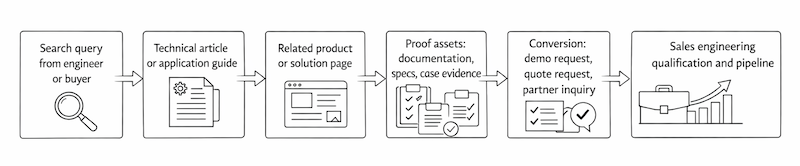
AI is now embedded into search experiences that shape visibility and click behavior. Google’s “How AI Overviews in Search work” documentation states that AI Overviews use generative AI to provide key information with links, and that they use a customized Gemini model working in tandem with existing Search systems like ranking systems and the Knowledge Graph.
For site owners, Google’s Search Central guidance is direct: the best practices for SEO remain relevant for AI features, there are no additional requirements to appear in AI Overviews or AI Mode, and there are no special optimizations necessary beyond good SEO fundamentals.
Google also notes that these AI features may use a query fan out technique, issuing multiple related searches across subtopics, and then surfacing supporting pages.
This shifts the strategic focus for robotics brands:
You need content that can serve as a reliable supporting citation for nuanced technical questions. You need strong internal linking so AI surfaced discovery can route users to the next page that answers the next question.
AI also intersects with publishing workflows. Google’s guidance on using generative AI content emphasizes creating content that is helpful and, when automation is used, considering transparency about how content was created in a way that makes sense for your audience.
For engineering readers, that can mean disclosing test setups, simulation assumptions, and what has been validated on hardware versus synthesized.
Robotics companies should measure organic search like a pipeline input, not like a vanity traffic chart.
At the platform level, Google Search Console is the primary system of record for how a site performs in Google Search results. Its Performance report includes metrics such as clicks, impressions, and query level visibility.
Google also states that traffic from AI features is included in overall search traffic in Search Console reporting, within the Web search type.
At the business level, you want to connect organic visibility to the actions your commercial team cares about:
Share of voice for high intent application queries. Growth in non branded impressions for category and problem terms. Technical health indicators that correlate with discoverability, such as indexed coverage for priority pages and reduced duplication.
Lead quality indicators, such as conversion rate to demo requests and the percentage of conversions that meet qualification thresholds.
If your analytics setup and CRM attribution model are not specified, it is not possible to prescribe an exact KPI dashboard. However, the best practice is to combine Search Console visibility signals with on site conversion tracking so you can identify which technical topics and solution pages contribute to revenue outcomes.
If you want impact in a quarter, not just in a year, start with a disciplined sequence.
First, establish indexation control. Confirm that important templates can be crawled, that robots.txt is not accidentally blocking critical resources, and that you are using noindex appropriately when you truly intend to keep pages out of search.
Google is clear that robots.txt is not a mechanism for keeping a page out of Google; it is primarily for controlling crawler access.
Submit and monitor sitemaps to help discovery, while remembering that a sitemap is a hint, not a guarantee.
Second, fix duplication and parameter sprawl. Implement canonical signals for duplicates and make deliberate decisions about which filtered or parameterized URLs should be crawled or indexed.
Third, publish a small set of engineering first assets that map to high intent research. Pick three application areas where you can credibly demonstrate technical leadership and where your sales team wants more qualified conversations. Use Google’s guidance as the filter: the content should be created to benefit people and demonstrate expertise, not to chase rankings.
Fourth, operationalize for AI shaped discovery. Since AI Overviews and AI Mode can surface a broader set of supporting links and rely on multiple related searches, build internal link paths from explanatory content to product selection content to conversion points.
Finally, if you need specialized help aligning SEO with large language model driven discovery and technical content systems, work with a partner that explicitly focuses on this intersection, such as LLM SEO Agency.
Two high authority references worth keeping open while executing are Google’s own documentation on AI features and your website and McKinsey’s research on B2B buying behavior in its B2B Pulse survey insights.
Filed Under: Artificial Intelligence, Communications
Copyright © 2026 · News Pro on Genesis Framework · WordPress · Log in
Our website relies on ads to provide free content and sustain our operations. By turning off your ad blocker, you help support us and ensure we can continue offering valuable content without any cost to you.
We truly appreciate your understanding and support. Thank you for considering disabling your ad blocker for this website