AI Search
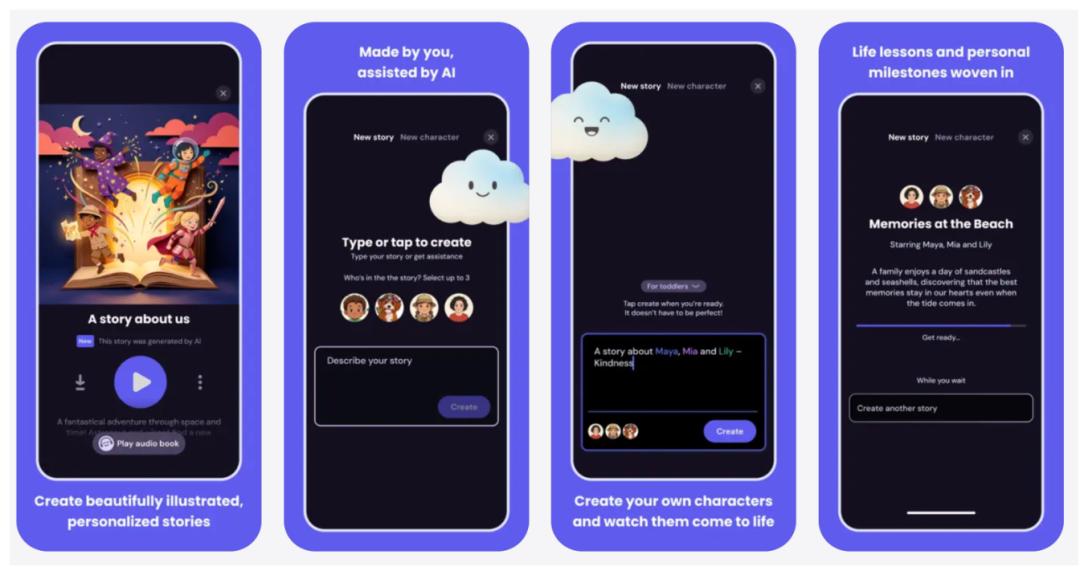
According to Duozhi’s report on July 22, Meta recently quietly launched a new AI application called StoryKit, which uses AI to create personalized children’s stories complete with illustrations, narrations, and original music.
StoryKit is designed for personalized stories. Meta has told TechCrunch that the app is currently in beta and is only available for download on the App Store in select countries.
It is understood that StoryKit is currently available for download and experience in Mexico, but has not yet been launched in the United States.
StoryKit is described as a creative story creation application for making personalized, imaginative bedtime stories for children.
StoryKit promises to generate a complete story through three options.
Users can create or photograph a character, choose a setting (such as a magic forest or a distant galaxy), and select a moral theme involving values such as kindness, courage, or empathy.
To generate a story in the app, you first need to select a character, then a setting, and finally determine the moral theme. According to the description in the App Store, users can “take a photo of their favorite toy or person and bring them to life” to create a character. Then you describe the story’s world and choose a moral theme, such as a magic forest or a distant galaxy, which allows you to “incorporate values like kindness, courage, or empathy without it feeling like a lecture.”
Meta says StoryKit can then generate stories in multiple formats:
Picture book — swipe through illustrated pages with narration and background music;
Audiobook — hands-free, screen-free listening ideal for car rides, bath time, or before bed;
Read-along mode — displays the full text on your phone, letting you act as the storyteller yourself;
Printable PDF — a physical keepsake that can be doodled on, snuggled up with, and shared with friends.
AI-generated children’s stories can be considered one of the earlier applied scenarios of generative AI landing in the children’s content sector.
The first batch of AI children’s story applications emerged around 2023. At this stage, product forms were relatively simple, mainly relying on users to input keywords, with AI automatically generating story content paired with AI-generated illustrations. However, as market competition intensified, some early products gradually entered the maintenance phase, and representative products that still maintain active updates include Germany’s Oscar Stories and the US’s Storytime AI.
Around 2024, AI children’s story products began to upgrade from “content generation” to “personalized experience.”
For example, products such as Turkey’s KidStory AI and the US’s AI Stories For Kids have added capabilities like character customization, interactive choices, and illustration generation on the basis of story creation, making the story content more strongly connected to individual children.
In the past two years, a new generation of AI interactive story products has emerged in the industry, shifting the focus from “AI tells stories for children” to “AI accompanies children to create stories.”
For example, products such as the US’s Giant and StoryQuest allow children to transform from passive listeners of stories to participants and co-creators of stories through AI character interactions, personalized plots, and branching adventure experiences.
Among them, Giant enhances children’s sense of participation through interactive narratives, exploring the evolution of AI stories from content consumption to immersive experiences. In February this year, the company completed an $8 million seed round of financing.
(Global AI Children’s Story Apps)
At the same time, smart hardware is becoming an important landing carrier for AI children’s stories, driving the track to extend from pure software applications to the direction of “AI + Hardware.” In overseas markets, products such as Toniebox and Yoto, which Duozhi has previously reported on, provide children’s audio content services through hardware forms; in the domestic market, various learning machines are also equipped with AI story capabilities, and AI children’s companion devices such as Duoji AI Foreign Teacher, Lingyuzhou Little Cube, and Listening Hero have emerged. Children’s content brands including Kaishu Storytelling and Hongen have also begun to explore the AI hardware direction, integrating AI story capabilities into their product systems.
However, the recently launched StoryKit takes a different path. Unlike AI story applications designed for direct use by children, StoryKit is positioned as a creation tool for users aged 18 and above, more like a “parent-side” product that helps parents make personalized, imaginative storybooks for their children. The app emphasizes the use of AI safety filtering mechanisms and does not provide social features.
It remains to be seen whether StoryKit will further expand into the global market in the future.
In fact, large language models all have the ability to generate stories, but AI children’s story apps aim to build a “complete experience in children’s scenarios.” It can be said that the AI children’s story industry is not competing with large language models, but fighting for the children’s entry point in the AI era.
This article is from the WeChat public account “Duozhi Wang” (ID: duozhiwang), written by Wang Shang, and published by 36Kr with authorization.
该文观点仅代表作者本人,36氪平台仅提供信息存储空间服务。
36kr Europe (eu.36kr.com) delivers global business and markets news, data, analysis, and video to the world, dedicated to building value and providing business service for companies’ global expansion.
© 2024 36kr.com. All rights reserved.